


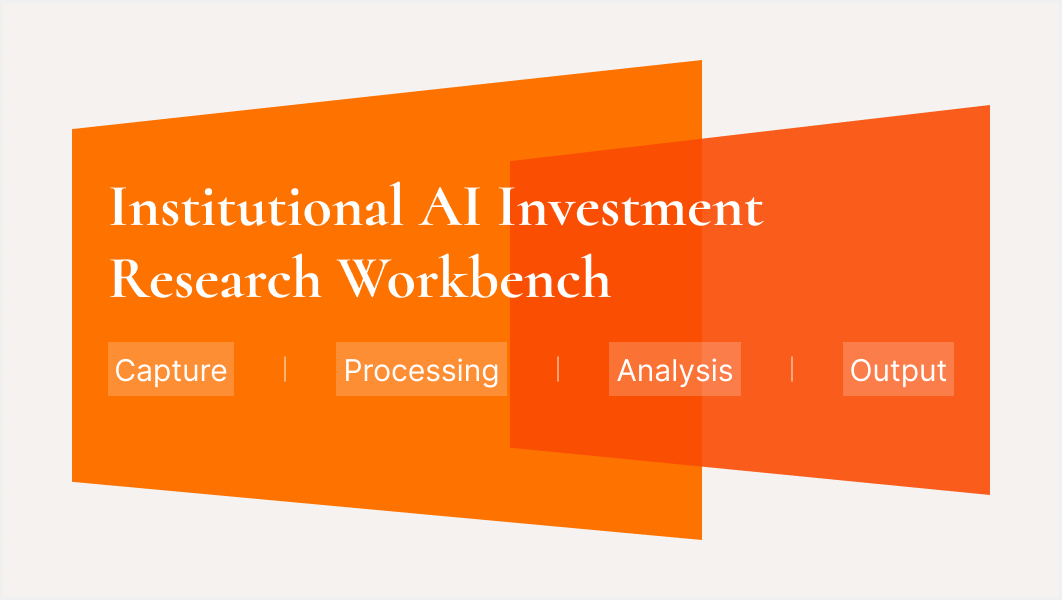
Institutional AI Investment Research Workbench
Key Takeaways
- Workbench ≠ bookmark folder: the goal is a closed loop from information capture → processing → analysis → output—not another tab farm.
- Software and hardware both matter when the highest-signal data is created in meetings, on devices, and inside messaging—not only in a browser.
- Domain ASR and financial lexicons turn audio into trustworthy inputs; generic transcription is where institutional workflows silently break.
- Finenter AI Assistant runs a four-stage intelligence loop on top of that data; OpenClaw extends execution for agent-style automation where schedules and tools matter.
In capital markets, the loudest vendor is rarely the one rebuilding plumbing. The uncomfortable truth is simpler: most “research stacks” fail at the integration layer—not because analysts lack tools, but because tools and content stay fragmented. Finenter’s bet is that an institutional AI investment research workbench must behave like infrastructure: WebRTC-era communication foundations, capture devices when needed, and a workflow layer that converts messy reality into auditable research artifacts.
Why Research Stacks Break at the Integration Layer
Buy-side and sell-side teams rarely suffer from a shortage of applications. They suffer from handoffs:
- A roadshow lives in one system, notes in another, and the final memo in a third.
- “AI features” sit on top of PDFs and chat windows, but the entity layer (who said what, which number moved, which risk phrase matters) is inconsistent across steps.
When each step uses a different object model, the team becomes the integration layer—exactly the failure mode Finenter targets with a workbench posture: fewer dead ends between capture and decision.
From Platform to Workbench: What Changes Operationally
Finenter’s 2025 positioning shift—from an institutional AI research platform to an institutional AI research workbench—is not cosmetic naming.
A platform often optimizes for coverage: more content types, more modules, more integrations. A workbench optimizes for continuity: one repeatable path that moves a research question from raw inputs to reviewed outputs with fewer context resets.
Operationally, that means designing around a loop Finenter states explicitly: acquire → process → analyze → deliver. The point is to reduce “unforced errors” where analysts re-type numbers, re-find sources, or re-argue about what was said in a meeting because the transcript was not trustworthy the first time.
Software + Hardware: Communication Infrastructure, Not Just Features
Finenter’s history in financial communication—including WebRTC-era roadshow infrastructure—matters because research workflows are not web-only. High-signal information is created in calls, roadshows, and on-site conversations.
Hardware enters where capture quality determines downstream value: domain-tuned recording and transcription (for example, Finnote-class devices) is not a gadget story; it is a data-quality story. If the first mile is wrong, the “AI summary” is fluent nonsense—something Finenter acknowledges by pairing capture tools with financial ASR tuned on long-accumulated lexicons rather than generic speech models.
For a deeper dive on transcription mechanics, see the financial terminology transcription workflow.
The Four-Stage Intelligence Loop (Finenter AI Assistant)
Finenter positions Finenter AI Assistant as the super-agent layer that sits above captured data. The workflow is intentionally staged:
- Acquire — aggregate research reports, roadshows, filings-style information flows, and meeting content into a coherent working set.
- Denoise and structure — reduce fragmentation; separate noise from decisions; preserve entities.
- Reason — connect evidence across sources instead of summarizing one document at a time.
- Signal generation — turn repeated patterns into actionable prompts for investors, not generic bullet points.
This is where OpenClaw fits as an execution-oriented complement: scheduling, tool use, and “get the task done” automation for research operations that should not remain manual click-work. For day-spanning automation patterns, pair this mental model with the AI agent investment research automation guide.
Domain ASR and the Data Flywheel
Generic large-model transcription fails in finance for predictable reasons: rare proper nouns, cross-language tickers, and industry jargon that do not appear in everyday speech. Finenter’s approach combines domestic model partnerships (for typical compliance expectations) with a long-nourished financial lexicon and correction loops—so transcription errors cluster away from high-impact tokens.
The flywheel is straightforward in concept: better transcripts attract more usage; more usage generates more validated corrections; corrections improve models; improved models reduce analyst cleanup time. The economic outcome is not “cheaper ASR,” but higher trust bandwidth for analysts.
Compliance and Domestic Model Partnerships
Financial institutions frequently constrain cross-border data flows and vendor behavior. Finenter’s public narrative emphasizes consistent demo-to-production alignment and collaboration with leading domestic model teams—rather than a story where the demo uses one stack and deployment quietly uses another.
That consistency matters because procurement and security reviews are not evaluating a leaderboard score; they are evaluating whether the system your traders and researchers rely on is the system you audited.
Tools / Solutions
Finenter delivers the workbench as an integrated environment: communication-era infrastructure, capture tooling where needed, domain ASR, personal knowledge accumulation, and Finenter AI Assistant for staged reasoning and signal generation—extended by OpenClaw for agent execution where workflows cross systems and schedules.
If your priority is analytical reliability rather than slide aesthetics, benchmark Finenter against your current stack on one honest metric: time from primary-source capture to investment-committee-ready memo, including rework.
Pros and Cons
| Notes | |
|---|---|
| Pro: End-to-end intent | Workbench framing targets the integration tax, not “more features per tab” |
| Pro: Infrastructure credibility | Long-run financial communication footprint supports realistic capture scenarios |
| Pro: Domain ASR path | Lexicon + correction flywheel addresses finance-specific failure modes |
| Con: Change management | A workbench only wins if teams align on workflow standards—tooling cannot replace process discipline |
| Con: Hardware adoption variance | Device programs succeed only when compliance and ops teams co-design capture policy |
| Con: Vendor claims require proof | Benchmark on your own meetings and tickers—finance is too idiosyncratic for generic demos alone |
Frequently Asked Questions
What is the difference between an investment research platform and a workbench?
A platform often aggregates content and tools. A workbench is designed for a closed loop—minimizing handoffs between capture, cleaning, analysis, and output so teams stop paying an integration tax on every project.
Why combine software with hardware for institutional research?
Because the highest-signal information is often created outside a tidy browser session—in meetings, calls, and on devices. Capture quality and domain-tuned transcription determine whether downstream AI is analyzing reality or reconstructing mistakes.
Why do financial teams invest in domain-specific ASR?
Because errors cluster on rare, high-impact entities. Large financial lexicons and correction loops shift error risk away from the tokens that move markets—where generic models are weakest. See also the chain-of-thought research workflow for how reliable text inputs improve downstream reasoning quality.
Conclusion
Institutional AI investment research does not need another dashboard. It needs a workbench: communication-grade capture, domain-tuned transcription, staged intelligence, and execution automation where work spills across tools. Finenter’s blueprint is explicitly infrastructural—software and hardware as one system—so analysts spend time on judgment, not reconstruction.
Start Free Trial
Start Free Trial with Finenter to run this workflow on a live research case, validate the output with your team, and see whether the workbench fits your institutional process.
Related Articles
- Financial Terminology Transcription for Investment Research — how domain ASR and glossaries make transcripts research-grade inputs for the workbench
- AI Investment Research Workflow: From 70-Point to Reliable — chain-of-thought reliability patterns for model-assisted analysis built on the workbench data layer
- Buy-Side Relative Valuation Automation — valuation workflow that integrates roadshow and filing intake from the workbench data layer
Tags
- Institutional Research
- AI Workbench
- FinTech Infrastructure
- ASR
- Buy-side