


Stock Price Trend Analysis: A Buy-Side Workflow
Key Takeaways
- Stock price trend analysis is not a prettier screenshot—it is a defensible chain from interval facts to drivers to judgment.
- Buy-side work wins when segments are explicit: what moved, when it moved, and what kind of regime you are in.
- Separate macro/industry (ceiling), fundamentals (engine), and sentiment/flows/events (short-term friction)—or you will confuse volatility with thesis.
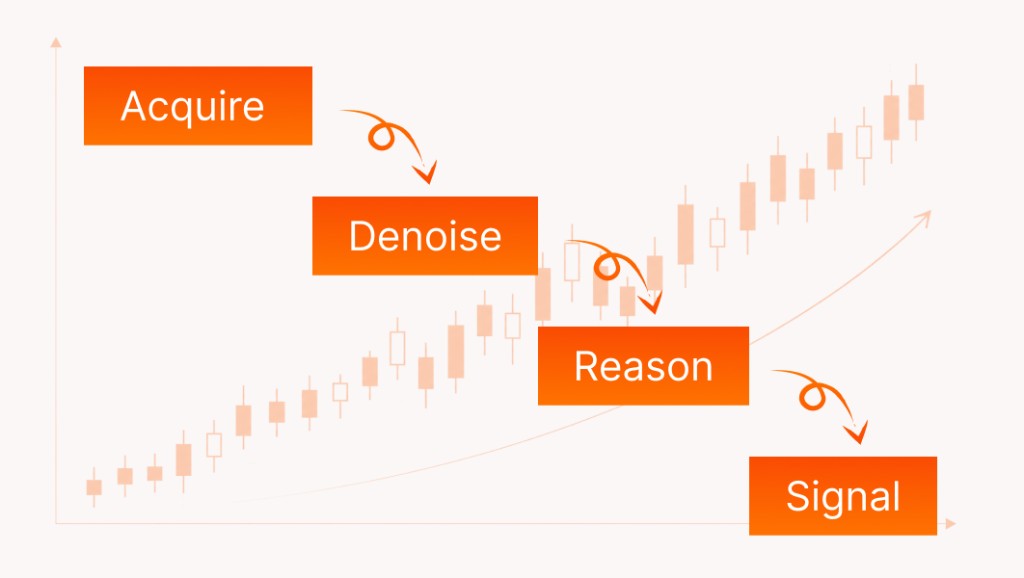
- Finenter turns this into execution with the Trend Review Agent: acquire → denoise → reason → signal—so charts and tables live inside the same institutional workflow as your memos.
When a PM asks for “the trend” on a name, stock price trend analysis fails when the answer is vibes. It succeeds when the desk can answer three questions in one pass: what price did, what likely drove it, and what would falsify your story. Anything else is a wallpaper chart.
A Price Chart Without a Thesis Is Just Wallpaper
Retail screens optimize for motion. Buy-side desks optimize for accountability: you need a timeline that matches your coverage process, a segment structure you can defend in a meeting, and a bridge from price to evidence—not a hot take.
That is why equity price action review belongs in the same category as investment research automation: the goal is not “fast” analysis. The goal is repeatable analysis—where the same inputs can be challenged, updated, and reused when the next filing lands.
Step 1 — K-Line and Tables: Make Intervals Tell a Story
The first job of stock price trend analysis is to make the interval legible. A candlestick chart answers “what happened visually.” A segment table answers what a PM will actually ask next: when a move started and ended, how long it lasted, and what type of sequence you are labeling (continuous advances, drawdowns, choppy mean-reversion).
Strong workflows explicitly surface longest continuous moves inside a chosen window, then let you sub-select sub-intervals for deeper analysis—because the point is not to admire the chart; it is to align narrative with time-stamped segments.
Tables are not “extra UI.” They are where a desk turns a chart into a shared object: comparable segments, comparable timestamps, and a common language for what counts as a regime shift.
Step 2 — Macro and Industry: Set Direction Before You Debate Noise
Before you argue about a single stock, stock price trend analysis needs a directional frame: what macro and policy environment are you in, and what does the industry’s demand and supply structure look like?
This is not macro tourism. It is ceiling and determinism work: does the sector have room to expand, or is it fighting a price war and overcapacity? Are you in a demand story or a margin squeeze story? Those answers set prior beliefs about what kinds of price moves are even plausible.
This section pairs naturally with sector-level workflows—see Industry Landscape Analysis—because the same PM questions will show up again: what game are we playing, and what is priced in?
Step 3 — Fundamentals: Where Sustainable Value Lives
Fundamentals are the engine of buy-side stock research. In a stock chart analysis workflow, the financial work should answer whether the company can keep earning, whether earnings are real, and whether the business model is strengthening or weakening.
That means going beyond headline growth numbers to sustainability: recurring revenue quality, margin structure, and the durability of the “why we win” story. It also means business logic—what is sold, how it is sold, where costs and technology actually matter—so the desk can explain why a segment move might be earnings-driven or multiple-driven.
When you connect this to valuation discipline, you stop treating price as a mystery and start treating it as an output of a model—pair with Buy-Side Relative Valuation Automation when the conversation moves from “what happened” to “what it’s worth.”
Step 4 — Sentiment, Flows, and Events: Short-Term Forces, Long-Term Discipline
Short-term price is not “fake,” but it is often misleading if you treat it as truth. Stock price trend analysis should treat sentiment as a constraint layer: flows can change liquidity and near-term demand for the stock; events can create step-changes in information.
Institutional workflows typically watch ownership dynamics and crowding risk (whether “consensus” is sticky or fragile), and they separate catalysts from noise: a surprise print, a large order, a leadership change—each can move the tape, but not all of them move the intrinsic story.
The discipline is simple: flows and events explain windows; fundamentals explain what survives the window.
Where the Trend Review Agent Fits as Execution
Generic chat can summarize. Buy-side work needs traceability: the same entities, the same sources, and artifacts that can be reused in a committee-ready narrative.
Finenter’s Trend Review Agent is designed as an execution layer on the institutional AI investment research workbench posture described in Institutional AI Investment Research Workbench: it connects price segmentation with driver scaffolding—macro/industry, fundamentals, and short-term forces—rather than treating charts as a standalone attachment.
If your goal is fewer “mystery moves” and more stock price trend analysis that your team can defend, the agent is meant to be the system that makes that workflow repeatable.
Frequently Asked Questions
What is stock price trend analysis in institutional research?
It is a structured review of how a stock moved over a chosen interval and what drivers plausibly explain those moves—linking price segments to macro, industry, fundamentals, and short-term forces—rather than a prediction of next week’s price.
How should buy-side teams combine charts with fundamentals?
Charts constrain the timeline and the segments; fundamentals answer whether the move reflects durable earnings power and competitive position—or transient noise and multiple expansion without support.
What belongs in a trend segment table versus a price screenshot?
A segment table encodes start/end timestamps, direction, length, and segment type so the team can debate regime changes and overlaps with catalysts; screenshots alone rarely survive a second question.
How do flows and events differ from intrinsic value drivers?
Flows and events can change demand for the stock and liquidity in the window; intrinsic drivers determine whether the business can compound value after the window closes.
How is Finenter different from generic charting or chat tools?
Finenter targets institutional workflows with traceable intake and repeatable outputs—so price work connects to the same research objects your desk already uses for meetings and memos.
Conclusion: Start Free Trial on a Live Name
Stock price trend analysis earns its keep when it produces challenge-ready output: segments you can timestamp, drivers you can rank, and judgment you can separate from noise.
Start Free Trial
Start Free Trial with Finenter to run this workflow on a live research case, validate the output with your team, and see whether the workbench fits your institutional process.
Related Articles
- Buy-Side Relative Valuation Automation — the multiples workflow that converts price trend insight into a defensible valuation call
- Institutional AI Investment Research Workbench — the full workbench architecture that integrates price trend work with roadshow and filing intake
- Stock Unusual Movement Monitoring Workflow with AI — real-time intraday surveillance that flags the anomalies your trend review needs to investigate
Tags
- Equity Research
- Buy-side
- Price Action
- Automation
- Workflow